
Any level of skill can participate, there is no age limit, no learning curve, and the idea of failure is dissolved.
Leon Mentz
This simple act, which can be completed with success and without judgment, makes the participant feel confident. This experience of success promotes embodied learning. Facilitators can for instance ask someone in a drum circle to think of the day they have had so far and to play what it ‘feels like’ on the drum.
All of this has a positive effect on stress and anxiety levels.
Equally, issues that undermine relationships become evident in the way people play music together; power differentials are easily identified as are communication deficits.
Probably the most critical exercises are those that draw on music’s implicit relationship to emotion. Music is often referred to as a language of emotion and, as such, lends itself to helping people identify, express, and control their emotions.
Therapists around the world using the medium of group drumming have received consistent feedback on the power of the instrument to assist them in working through emotional blockages with those in their care. The use of the drum to help identify feelings is critical, especially for those impacted by trauma, who often struggle with wording their feelings and words themselves can readily be used to disguise feelings.
The impact of our feelings on others and vice versa can be examined through exercises where individuals play contrasting emotions (rhythms) on their drums aside one another. Equally, the role of peer pressure in bending our emotional will, or triggering emotional arousal, can be replicated through individuals playing opposing rhythms and one person trying to hold their own rhythm steady against the undermining influence of the other part.
Learning the drum, then, often is about ‘unlearning’ old learning processes based on cognition and allowing and trusting the body to internalize and reproduce the beats. In this process, there also appears to be a certain degree of ‘letting go’ of thoughts and analysis, in favour of trusting the body to learn and remember.

“School of rock” band practice session. Real live band practise sessions with other musicians!!
Check out https://gigefy.band/
Find a teacher for your instrument “Piece together can help you find the perfect teacher for your chosen instrument. You can be connected to a teacher appropriate to your skill level and close to you.
A study published by the journal; Brain and Behaviour found that drummers brains were associated with a more efficient neural design structure of cortical motor areas as well as a stronger link between commissural structures and biochemical parameters associated with motor inhibition. https://bbrfoundation.org/
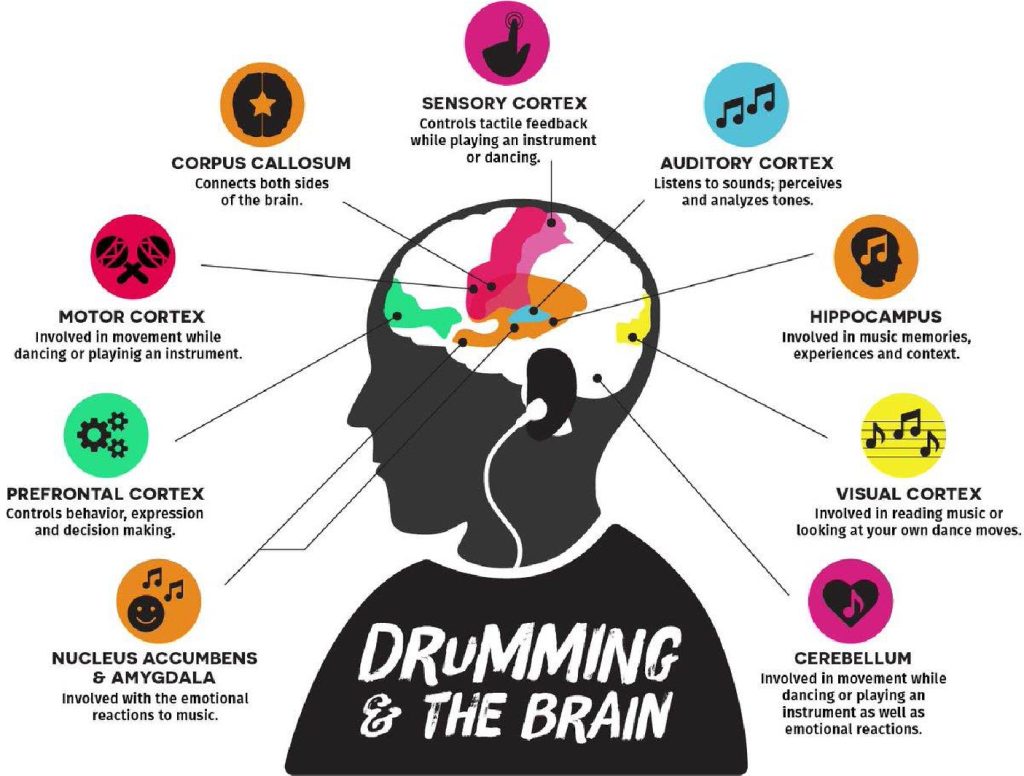
A study published by the journal; Brain and Behaviour found that drummers brains were associated with a more efficient neural design structure of cortical motor areas as well as a stronger link between commissural structures and biochemical parameters associated with motor inhibition.
This is especially true when dealing with more intense emotions like anger, frustration, anxiety, and excitement.
30 minutes of drumming can use up to 200 calories and increase your heart rate up to 155 beats per minute.
Behind a modern drumkit, both feet and legs are also used amplifying the physicality of the experience.
Playing drums has been found to release endorphins, which reduce pain and induce feelings of relaxation. Drumming can also lower bold pressure and reduce inflammation.